
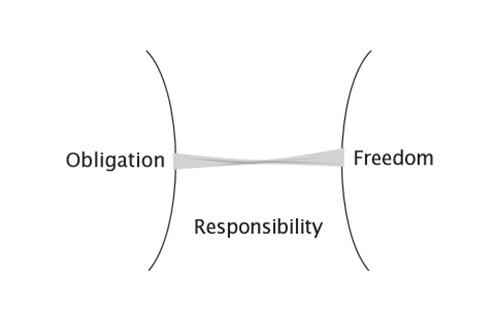
I was smacked between the eyes with a profound recognition recently, about the dynamic tension between freedom and obligation and the important place of responsibility.
I am currently co-facilitating a leadership course with ICA Canada group about ‘The Courage to Lead’ by Brian Stanfield. It has been profound in every way. After attending as a participant last year, I decided that there was so much gold in it that had to delve deeper. As a facilitator I can’t help appreciating the structure of the course and the book on which it is based. Elegant! This is not unfamiliar territory to me, having led others in community and at work, as well as delivered leadership training over time, but there is something about this one that connects. I want to turn this knowledge into wisdom in my other work delivering whole person facilitation training with Zenergy Global Australia (#2) and in my work as a social ecologist.
What is really needed here?
In Chapter 6 Stanfield addresses the issue of inclusive responsibility. Essentially the chapter is about making ethical decisions. On reading this chapter I was really smacked between the eyes with both personal recognition and its application to society generally. Anchored in the ethics of responsibility, it focuses on the dynamic relationship between acting from obligation and acting from freedom. Standfield explains that the choices we are faced with today are often more complicated than just deciding right and wrong and suggests that we need to ask the question, ‘what is necessary?’.
He asserts that moral principles are like laws, and as such are relative conventions. As often as not, as leaders we must decide between right and right, or wrong and wrong. In many of the situations we must deal with, there are no rules. We only have our critical intelligence to determine what is really needed and what is responsible. Not what is good or bad but what is befitting and appropriate.
Obligation is about what others expect and want from us – our family, friends, workplace, community or country. It asks what commitments have I made to these people and organizations? What do the creatures and ecosystems of the earth ask of me? What principles values or laws am I expected to obey?
Freedom is about what I want – what I am driven to do, think and be. When I am operating from my own deepest intuition, yearnings and passions, I am experiencing freedom. When I look deeply inside myself, I discover the unique person who is free to be me.
As human beings we show up obligated. And we also show up free. We cannot do either/or, as leaders we need to consider both.
Freedom without obligation is all about me. Out of control, no self-regulation, more, more, more. It is anything from eating the whole big bar of chocolate with no self-restraint – to the consumeristic excesses of the western world. Disturbing enough, but often it is about ‘power over’ others, acting as if my claims to validity are more important than theirs.
Obligation without freedom is being a slave to duty, to approval or to obedience. When we abandon freedom, and only do as we are told without question, we become a slave to our family, communities and organisations.
This was the kicker for me. I recognised both the extremes of either/or in myself, in society and at work. Ugg! I want to hastily add that I am not a complete ditz and do consider what is necessary most of the time. But, there are times when I have vacillated between the two extremes without due consideration of what is ethical, responsible, or necessary. You know, the times you have said yes when you really meant to say no, or when you haven’t asked what the purpose is for the action being demanded; or making something only about self without considering the needs of others in the situation.
Seeing the dynamic tension between these two forces was a good reminder to consider the importance of holding both freedom and obligation together when acting responsibly as a leader. Otherwise, obligation and freedom in their extremes can look a lot like unthinking compliance or self-importance. Really neither of these is a good look in a leader.
#1 This article was based on the work of ICA, Canada, and ‘The Courage to Lead’ by Brian Stanfield. (2nd Edition).
#2 The reference to my work is with www.zenergyglobal.com.au